
On this page
Key takeaways
- Valuation is the level of protection you choose for your belongings; it is not insurance, but it works like paying for protection in case something breaks.
- At Bailey's Moving & Storage, customers are opted into Full Value Protection, which has a cost, unless they choose released value; it covers lost or damaged items by repair, replacement with a similar item or a cash settlement.
- Released value is basic coverage paid by weight per article, so an expensive but light item is repaid at a small fraction of its worth, and it applies only if you choose it.
- Damage inside a box you packed yourself is not covered unless the box shows outside damage, while boxes the mover packs are covered under the valuation you chose.
- Very high-value items, like artwork and antiques, must be disclosed separately and in writing before the move to be covered at full value.
Moving shouldn’t feel confusing or risky when it comes to protecting your belongings. After completing more than 100,000 moves, we’ve seen how much stress valuation misunderstandings can cause. That’s why we walk you through your options clearly, so you can move forward feeling confident and protected.
If you’re relocating and reading reviews to find a good moving company, read between the lines before ruling out a company based on a few negative reviews. We have insights into how certain unhappy customer reviews can inadvertently sway you away from a good mover.
The confusion around what happens if something breaks during a move can cause frustration with moving companies. Before you say, “No way,” let us explain why a bad moving company review might be more about a missed opportunity for property damage coverage than poor customer service.
What is Valuation & Why You Shouldn't Ignore It When Hiring a Moving Company
You weigh a moving company’s cost and competency, but do you ask how much it will cost to replace your belongings if they get lost or broken during your move?
Valuation is one of the most important and misunderstood parts of protecting your belongings. Some movers are better trained, more experienced, and take better care of their customers’ belongings, but life is unpredictable and things still are lost or damaged.
Are You Willing to Take the Chance? Can You Afford to Replace Expensive Items?
You count on the unpredictable and hope 100% of your stuff will arrive unscathed when you check the box for Released Valuation. You might assume since you’re not going far or that the best moving companies hardly ever break stuff.
The cost of Valuation is less than the cost to help replace an expensive item if it breaks on moving day. Is the amount you save by essentially waiving the optional valuation worth the cost of replacing a $1,400 TV?
In reality – moving is messy and things break even in the most capable hands. You can minimize your risk and breathe easier on your moving day. Include Full Valuation when you hire a mover to mitigate the financial impact when stuff breaks.
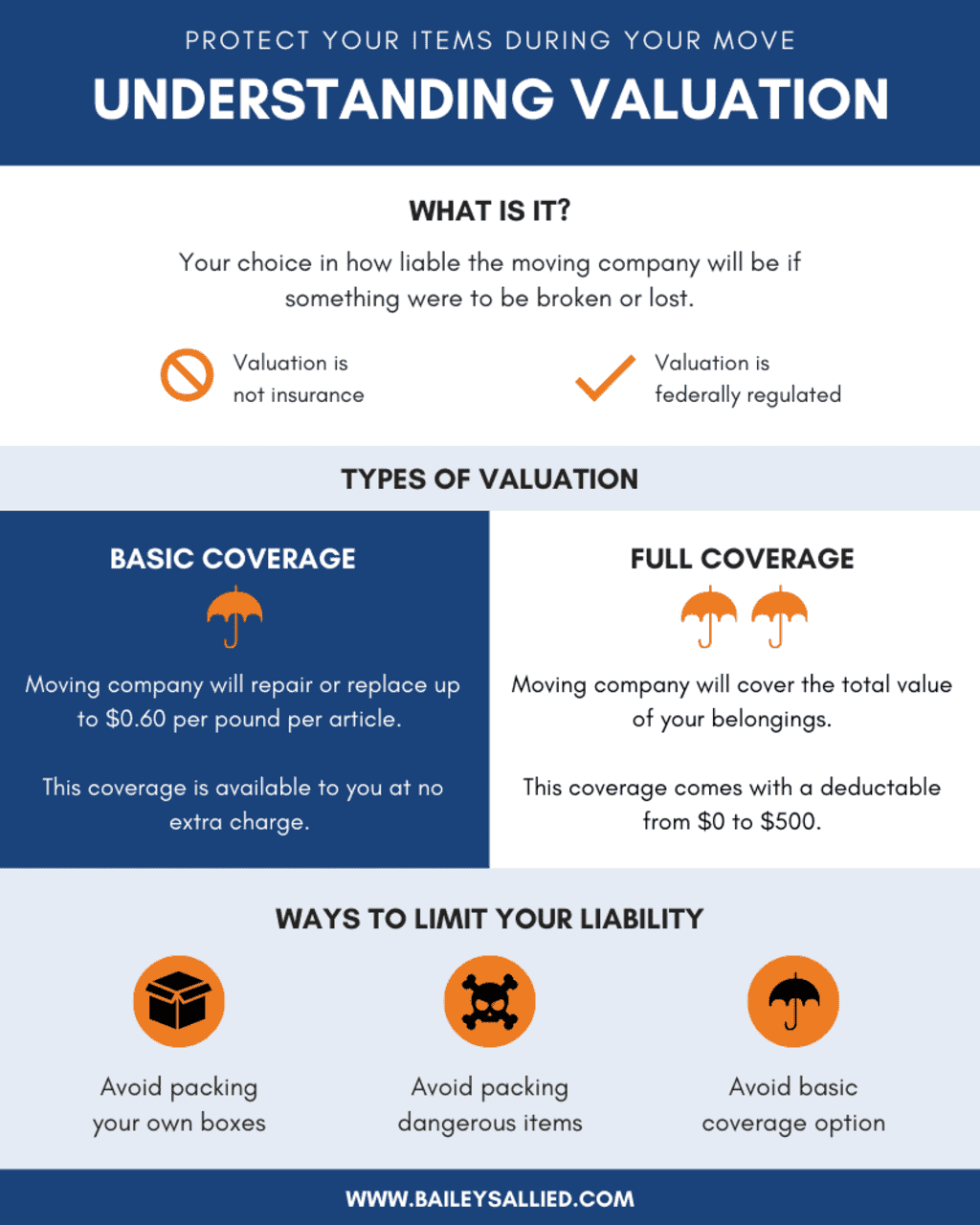
Enter: Valuation. Valuation represents your choice in how liable the moving company will be if something gets broken or lost.
How Does Valuation Work and Why Does It Work Like This?
If you’ve shipped an item with UPS or FedEx, “declared” its value, and chosen a protection amount, you’re familiar with valuation on a smaller scale. You choose a protection amount when you ship a package in case it breaks. Do you risk it? Or do you minimize replacement and repair costs?
Valuation with a mover works the same but on a larger scale. You’re shipping furniture, all those boxes and other items, and declare the value of the entire shipment (with the help of an estimator). Your Valuation is your chosen level of protection.
Per Federal law, we tell you that valuation is not insurance, but it’s easier to think of it as paying for protection in case something breaks.
How Much Unavoidable Risk Are You Willing to Take?
Moving your belongings across town or the country is a complex logistical task. Trucks, roads, weather, and timing add unpredictability. The best mover can’t control traffic jams, rough roads, breakdowns, or sudden weather shifts that contribute to lost and broken stuff.
That’s why valuation exists, so you can choose a Valuation amount that minimizes the financial impact of repairing or replacing broken items.
Not sure which valuation option is right for you? Our moving estimators can walk you through real examples based on your home, your belongings, and your budget. Ask us during your quote. We're here to help you choose the protection that fits your move.
Valuation Protection Works Both Ways
Valuation also protects moving companies from abuse. There’s a human side to this story. It happens more often than you think. People can take advantage of the moving process with claims like:
- “That scratch wasn’t there before”
- “You broke my mother’s antique that was worth a million dollars” (it wasn’t)
Customers who declare the value or total worth of everything being moved make it fair for the mover as well. You choose yours and the mover’s level of protection and risk.
Moving companies didn’t create this policy on their own. The entire valuation framework is set by the U.S. Department of Transportation and applies to everything shipped by truck, boat, or plane. It’s designed to create balance and fairness on both sides, so you’re protected, and the moving company isn’t unfairly penalized for what’s beyond their control.
You Have Two Valuation Options
Are You Feeling Lucky? You Can Waive It Entirely: Released Valuation
You can skip valuation and ‘roll with the punches’ if something breaks. It’s your choice! There is good news, though. You can thank Federal Law because it requires a basic level of protection for those who waive Full Valuation.
Released valuation is ‘basic valuation’, a moving company's minimal per-pound repair or replacement rate as described by Federal Law. The moving company isn’t liable for a declared value but is liable during your move at a minimal level. The company values your shipment at $0.60 per pound for each item to repair or replace if things are lost or broken.
But you must specifically ask for this basic option. If you don’t ask, moving companies are required by law to default to full coverage and include the extra costs. It’s one of the most common complaints that customers have about “unfair” moving companies.
So, what does $0.60 per pound look like in practice? Let’s say you bought a new 65-inch TV before the move for $1,400. Nice. OLED. Very fancy. The TV weighs 50 pounds. The truck hit a pothole and jostled the TV. Now, it won’t turn on. In this case, you’ll file a claim, and the moving company pays you $0.60 per pound – let’s do the math.
50lbs multiplied by $0.60 per pound = $30
Bottom Line: You would have $30 to replace a $1,400 TV.
$30 = You’re not happy!
Compare Basic to Full Valuation
You choose the value of your shipment with full replacement coverage. The moving company will cover your belongings for that amount, subject to a deductible. That deductible can be $0, $250, or $500. The deductible you choose fully covers your stuff, but it will change the cost of the protection and is subject to your deductible.
With full coverage, if something breaks or is lost, one of three things will happen.
- The item will be repaired
- The item will be replaced with a similar item
- A cash settlement for the item will be reached
Let’s revisit the $1,400 TV! In this case, the moving company will first see if it can be repaired. If not, they will attempt to replace it with a similarly valued item or provide a cash settlement for the value of the TV minus your deductible.
The Federal Government requires movers to protect customers with basic coverage, but this policy is limited to $100 per pound of weight of any article. High-value belongings valued at more than $100 per pound of their weight, such as artwork and antiques, aren’t covered at their full value without additional discussion before the move.
Disclose these items separately and in writing before your move, to cover them at their full value. Always ask your moving estimator or company about potentially high-value items, so they can have a form ready for you.
The One Coverage Exception, Even in Full Valuation: Why the Stuff You Packed Isn't Covered
Who Packs it is Responsible - Don’t Limit Your Liability!
There are a few things a moving company will and will not cover in the event of loss or damage. First, moving companies will not cover damage that occurs inside a box you pack. They need visible evidence that the box was damaged by them (on the outside). This, because it’s too easy for people to hide damaged items inside a box and claim it later as the moving company’s fault.
Damage to contents inside a box is most common when items aren’t packed properly, or contain hazardous or dangerous contents, and no matter how careful the moving company was in moving them, it’s a serious risk. For this reason, you take responsibility when you pack your own boxes.
Conversely, a moving company is responsible for fixing, replacing, or paying for any items that break inside a box they packed, based on the valuation policy you selected.
Why it’s a Big Source of Bad Moving Company Reviews
For whatever reason, this is one of the steps most customers skip when finalizing their estimates. Moving already costs a lot, and it can feel hard to justify paying extra for something that seems like it should be the mover’s responsibility.
But because there are so many risks that fall outside of a moving company’s control, from road conditions to how items were packed, valuation is treated as an optional add-on. You can decline it if you truly want to, but doing so means accepting more personal risk.
When people skip this step, they often don’t realize what that means until something breaks. Then, when the mover explains the limited coverage, it comes as a surprise, and that frustration often turns into a bad review. If you read enough reviews of any moving company, you’ll start to see a pattern: “They didn’t fix what they broke,” “They walked away from responsibility,” or “They didn’t care about my grandma’s antiques.”
And while that may be true for a few bad actors, the truth is most moving companies genuinely care about your belongings. There’s just a process that has to be followed, and valuation is a big part of that process, so don’t skip over it!
If you’re considering Bailey’s Moving & Storage for your move, read a few of our reviews.
FAQ: Moving Valuation & Protecting Your Belongings
1. What is moving valuation?
Valuation is the amount of protection you choose for your belongings during a move. It determines how financially responsible the moving company is if something is lost or damaged. Unlike insurance, valuation is governed by federal law and applies to all moving companies.
2. Is valuation the same as moving insurance?
No. Federal law requires movers to tell you valuation is not insurance. But in practice, it functions similarly: you select a level of protection so you’re compensated if something breaks. Insurance is purchased through a third party; valuation is provided directly by the mover.
3. Do movers automatically include coverage?
Yes. If you do nothing, federal law requires movers to default you into Full Value Protection, which has a cost. If you want the free, minimal Released Valuation ($0.60/lb), you must specifically request it in writing.
4. What’s the difference between Released Valuation and Full Value Protection?
Released Valuation (Free):
- Pays $0.60 per pound per item
- A 50 lb TV = $30 reimbursement
- Minimal protection
Full Value Protection (Paid):
- Covers repair, replacement, or cash settlement
- You choose your deductible: $0, $250, $500
- Best for protecting high-value or essential items
5. Why do some customers get frustrated about claims?
Most bad claims experiences happen because a customer didn’t fully understand valuation before moving. If coverage is waived or not adjusted correctly for expensive items, the reimbursement may be far lower than expected.
6. Are items I pack myself covered?
Movers will not cover damage inside a box you packed yourself unless there’s clear external damage to the box. If you want full protection for boxed items, have the moving company pack those boxes for you.
7. Are high-value items automatically covered by moving company valuation?
Not always. Items worth more than $100 per pound—such as artwork, antiques, or collectibles—must be listed separately on a High-Value Inventory Form before your move for full coverage.
8. What happens if something breaks under Full Value Protection?
Your mover will:
- Try to repair the item
- Replace it with a similar item, or
- Offer a cash settlement (minus deductible)
9. Should I choose Full Value Protection or Released Valuation?
Choose Full Value Protection if:
- You have expensive electronics or furniture
- You want peace of mind
- You’re moving long distance
Choose Released Valuation only if:
- You accept the risk of minimal reimbursement
- You have very few valuable items
- Budget is your absolute top priority
10. Can I change my valuation choice later?
Yes—up to moving day. After the truck is loaded, valuation cannot be changed, since the coverage must apply to the items as they were packed and handled.
11. How do I know what valuation amount I need?
Your moving estimator can help you calculate a realistic shipment value based on your home size, item types, and any high-value belongings. If you’re unsure, choosing Full Value Protection with a moderate deductible is the safest option.
12. What’s the best way to avoid claims issues?
- Understand valuation options before moving day
- Disclose high-value items early
- Let movers pack fragile items
- Take photos of electronics and furniture
- Ask your estimator questions—no amount is too small
Moving Soon? Obtain a Free Moving Quote Today!
Are you planning an upcoming move and want to ease the overwhelm using full-service movers? You can obtain a free quote from us today for a better idea on pricing and our upcoming availability. We have offices in Denver, CO; Salt Lake City, UT; Grand Junction, CO; and Colorado Springs, CO and can do moves anywhere from down the road to across the world.
Frequently Asked Questions
What is moving valuation?
Valuation is the amount of protection you choose for your belongings during a move. It determines how financially responsible the mover is if something is lost or damaged.
Is valuation the same as moving insurance?
No. Federal law requires movers to tell you valuation is not insurance, but in practice it works similarly. Insurance is bought from a third party, while valuation is provided directly by the mover.
Do movers automatically include coverage?
Coverage depends on the choice made: at Bailey's Moving & Storage, customers are opted into Full Value Protection, which has a cost, unless they choose released value. Check your paperwork so you know which one you have.
What is the difference between released value and Full Value Protection?
Released value is minimal protection paid by weight per article. Full Value Protection covers repair, replacement or a cash settlement, subject to your deductible.
Are items I pack myself covered?
Damage inside a box you pack yourself is generally not covered unless there is clear damage on the outside of the box. If you want full protection for boxed items, have the movers pack them.
Are high-value items automatically covered?
Not always. Very high-value items, such as artwork and antiques, must be listed separately in writing before your move to be covered at full value.
Ready to find out what your move should cost? Get Pricing or call 888-260-5717.


